
PITBULL DOORS GUIDE • 10 MIN READ
Should you repair the glass or replace the complete window?
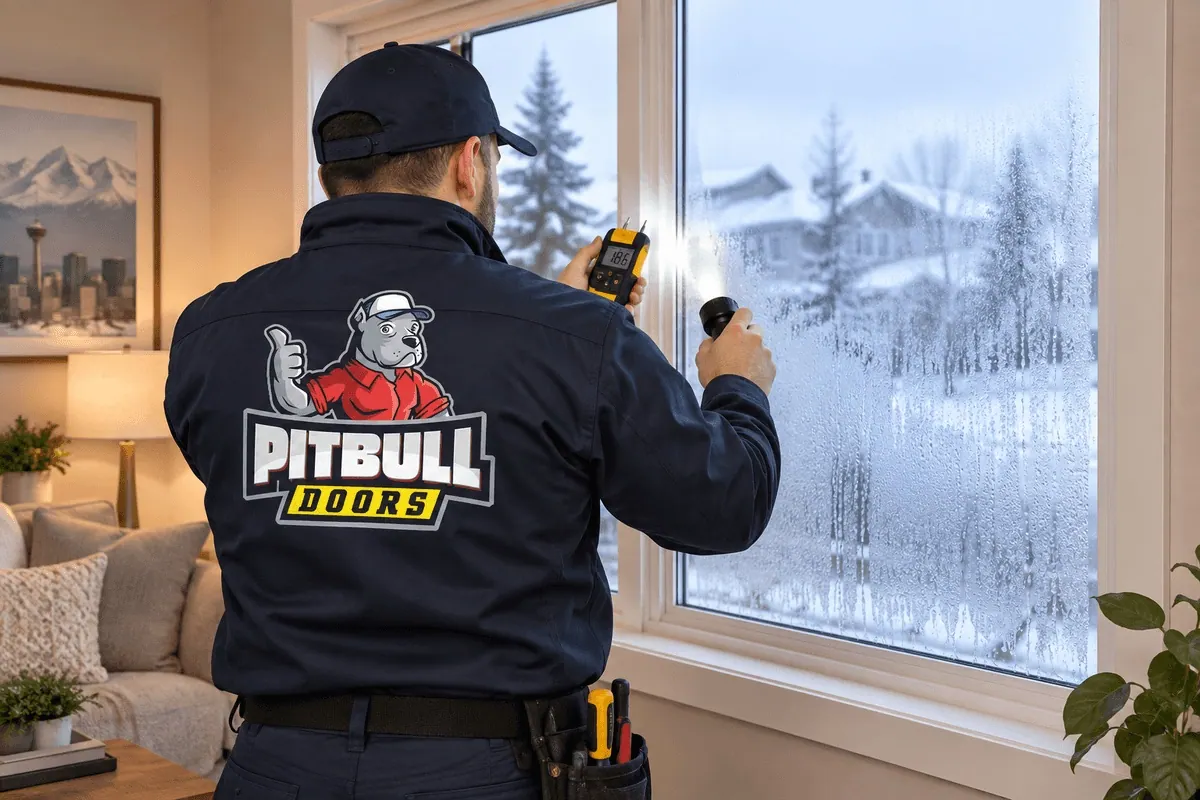
A foggy pane, cold draft or difficult handle does not automatically mean the complete window has failed. Windows are systems made of glass, seals, hardware, sash, frame, flashing and interior and exterior finishes. Identifying which part is causing the problem helps Calgary homeowners avoid paying for work they do not need—and recognize when a small repair would only postpone a larger issue.
Start by identifying what has actually failed
Two windows can show the same symptom for very different reasons. A draft may come from worn weatherstripping, a sash that is no longer aligned, an uninsulated gap around the frame or air movement near cold glass. Water may enter through the window system, the surrounding wall, exterior cladding or a drainage path above the opening. The visible symptom is important, but it is not a complete diagnosis.
A useful assessment separates replaceable components from the permanent parts of the opening. The glass unit, operator, lock, handle, rollers, weatherstripping and screen may often be serviced individually. The sash, frame and installation around the opening require a closer look because damage there can change the recommendation.
Pitbull Doors repairs windows installed by other companies as well as products we supplied ourselves. Photos and a clear description can help us prepare, but recurring leaks, frame movement and several simultaneous failures are best assessed at the property.
- What do you see: condensation, broken glass, staining, frost, a gap or damaged hardware?
- When does it happen: during wind, extreme cold, snow melt, rain or every day?
- Is the problem limited to one window or repeated throughout the home?
- Does the sash still open, close and lock squarely?
- Is there softness, swelling, cracking or staining around the frame and trim?
When insulating glass unit (IGU) replacement may be the right repair
Most modern double- and triple-pane windows contain a factory-sealed insulating glass unit. When the edge seal fails, moisture can enter the space between the panes. The result is persistent fogging, haze, droplets or mineral deposits that cannot be cleaned from either accessible surface. In that situation, cleaning the glass does not solve the problem because the moisture is inside the IGU.
If the sash and frame are structurally sound, operate correctly and remain suitable for the opening, replacing only the insulating glass unit (IGU) may restore visibility and the insulating glass component without removing the complete window. The new unit must be measured and ordered for the existing sash, with the appropriate thickness, spacer, coating, gas fill and safety-glass requirements for its location.
Glass-only replacement is not automatically the best value in every case. If several IGUs are failing, the frames are deteriorated or the windows no longer meet the homeowner’s comfort and performance goals, the cost of repeated glass work should be compared with complete replacement.
- Fog or moisture is trapped between panes—not on the room-side surface
- The frame and sash are solid and reasonably square
- The window opens, closes and locks properly
- There is no evidence that the surrounding opening is allowing water in
- A compatible IGU can be manufactured for the existing system
Broken glass does not always require a complete new window
Impact damage, thermal stress or an accidental crack can sometimes be addressed by replacing the glass unit rather than the whole frame. The correct approach depends on how the glass is retained, whether the sash was also damaged and whether the opening requires tempered or another type of safety glass.
A cracked insulating unit should be reviewed promptly. It may continue to lose its seal and its edges can present a safety concern. Temporary tape may reduce movement, but it is not a permanent repair and should not be relied on to restore weather resistance or structural performance.
Accurate measurements matter. Insulating glass is made to order, and a small error in width, height or overall thickness can prevent proper glazing. Pitbull assesses the existing construction before ordering the replacement rather than treating all panes as interchangeable.
Window components that can often be repaired
Hardware and seals work every time a window is opened, closed or locked, so they can wear before the frame reaches the end of its useful life. A failed crank operator, worn roller, loose handle or damaged lock may make an otherwise serviceable window feel as though it needs to be replaced.
Weatherstripping can compress, tear, shrink or pull away. Replacing it may improve contact between the sash and frame when the original profile can be identified and the window is still aligned. Simply adding generic foam over an existing seal can interfere with drainage or prevent the sash from locking, so the repair should match the window system.
Screens are another separate component. Pitbull can repair existing screens or build new screens. Screen work improves usability but does not correct air leakage through the window or water entry around the frame.
- Crank operators and opening hardware
- Locks, keepers, handles and hinges
- Rollers and components on sliding windows
- Window weatherstripping and selected seals
- Existing screen repair and new screen fabrication
- Minor adjustments where the sash and frame remain serviceable
Condensation: inside the glass or on the glass?
Where moisture appears changes the diagnosis. Moisture trapped between panes generally indicates a failed insulating glass unit (IGU). Condensation on the room-side surface can instead relate to indoor humidity, outdoor temperature, air circulation, window coverings and the temperature of the glass. Exterior condensation can occur under certain weather conditions and does not by itself prove the window has failed.
Calgary homes can experience large temperature changes, and indoor humidity that feels comfortable in mild weather may create condensation during a cold snap. Before assuming the window needs replacement, note which surface is wet, the outdoor temperature, indoor humidity and whether blinds or curtains restrict warm air from reaching the glass.
Persistent room-side water still deserves attention because repeated wetting can damage paint, wood, drywall and finishes. The solution may involve humidity control, airflow, a glass upgrade, an installation correction or a combination of factors.
Drafts need diagnosis—not guesswork
Feeling cold near a window does not always mean outside air is entering. Air leakage is moving air through a gap; radiant cooling and convection can make the area beside cold glass feel drafty even when the assembly is reasonably airtight. A visual inspection and operational check help distinguish these conditions.
Actual leakage may come through worn weatherstripping, an unlocked or misaligned sash, gaps between the window frame and wall, or incomplete interior and exterior finishing. Replacing glass alone will not correct a perimeter installation issue. Likewise, replacing weatherstripping will not solve a damaged frame or an opening that has moved.
Tell the assessor whether the problem changes with wind direction or occurs only at one corner. Photographs of frost patterns and gaps taken during cold weather can be useful even if conditions are different on the service date.
Water leaks must be traced beyond the visible stain
Water can travel behind finishes before appearing inside, so a stain near a window does not prove that the glass or window frame is the entry point. The source may involve exterior sealant, flashing, cladding, roof or wall details, blocked drainage paths, or the window itself.
The timing of the leak provides valuable clues. Wind-driven rain, spring melt and condensation create different patterns. Record the weather, wind direction and exact location where moisture first appears. If safe, photographs taken during the event are more useful than a dry opening several days later.
Soft materials, swelling, mould-like growth or repeated staining can indicate that the issue has been present for some time. Complete replacement may be necessary if the window or surrounding materials are damaged, but the water-management problem also needs to be identified so it is not concealed behind a new product.
When complete window replacement deserves serious consideration
Replacement becomes more practical when the failure is not limited to one serviceable part. A damaged or distorted frame, deteriorated sash, recurring water entry, widespread seal failures, difficult operation across several openings or significant gaps around the installation can make a series of isolated repairs poor long-term value.
Homeowners may also choose complete replacement to change how a window operates, improve ventilation, update the appearance, add easier-cleaning features or pursue a different glass package. Pitbull offers vinyl, fiberglass, aluminum, wood and European-style tilt-and-turn options through local, Canadian and international manufacturers. The recommendation should reflect the opening, budget and priorities rather than a single manufacturer’s catalogue.
Complete replacement allows the existing opening and surrounding conditions to be reviewed during removal. The project estimate should state what is included for removal, disposal, interior trim and exterior finishing, because those details vary by home and scope.
- The frame or sash is cracked, rotten, distorted or significantly damaged
- Multiple components have failed and repair costs are accumulating
- Water has affected the opening or adjacent finishes
- The product no longer closes or locks securely after reasonable adjustment
- Many windows of similar age show the same failures
- You want a different configuration, material or performance level
How to compare repair and replacement fairly
The lowest immediate price is not always the lowest total cost, but replacing a complete window that only needs a practical component repair is also unnecessary. Compare the scope, expected result, condition of the remaining components and likelihood of additional work—not just the first invoice amount.
For a repair, ask which component is being replaced, what the repair is expected to correct and what remains unchanged. For replacement, confirm the frame material, glass package, operating style, removal method, disposal, finishing, timeline and warranty. Pitbull provides a 10-year workmanship warranty; product and manufacturer warranty terms vary and are confirmed with the buyer.
A written estimate is particularly important when comparing proposals. Two prices may describe very different levels of finishing or different assumptions about the existing opening. Pitbull estimates are valid for 30 days, and final measurements and product details are confirmed after approval.
What to prepare before requesting service
A few clear details help the team route your request correctly. For repairs other than directly bookable weatherstripping service, Pitbull generally reviews the issue first. This helps determine whether parts, measurements or an on-site assessment are likely to be needed.
Photograph the complete window from inside, the problem area, any manufacturer label you can safely access and the exterior if practical. Include an approximate size, the room and floor, how the window operates and when the symptom occurs. Do not remove glazing stops or dismantle hardware solely to take a photograph.
Free in-home consultations are available for replacement projects and can be booked directly. Pitbull works year-round, including winter, when weather conditions are suitable for safe and appropriate installation.
- Your Calgary-area address and preferred contact information
- Photos showing the full window and close-ups of the problem
- Approximate width and height if readily available
- A description of when and how the problem occurs
- The number of affected windows
- Whether you prefer repair, replacement or an unbiased assessment
The practical answer: assess the whole opening first
There is no honest one-rule answer to repair versus replacement. Fog between panes in a sound sash may point to insulating glass unit (IGU) replacement. A worn operator or weatherstrip may be a focused repair. A damaged frame, recurring leak or group of aging windows with repeated failures may support complete replacement.
The goal of the consultation is to match the work to the actual condition of the window and the homeowner’s plans. Pitbull can provide glass-only replacement, component repairs and complete window replacement, which allows the recommendation to begin with the opening rather than a predetermined product sale.
Service across Calgary and surrounding communities
Pitbull Doors serves Calgary, Airdrie, Cochrane, Chestermere, Okotoks and High River. Projects farther away can be reviewed individually. Product availability, travel and installation conditions are confirmed before work is scheduled.
Free consultations are available for replacement projects. Most repair requests are reviewed from a description and photos first so the team can identify the likely service requirements.